River Ranger
RIVER Ranger Programme is a holistic river education programme for the local communities and schools covering general environment issues, water resources and rivers, and emphasizes on every aspect of freshwater ecosystems, including its biodiversity, functions, values, and benefit to people. It also includes practical activities including pollution monitoring, pollution mapping, and simple ways on how to make sure their river stays clean.
The RIVER Rangers training will provide an overview/concept of integrated river basin management and will involve practical field training that exposes the participants to the real situation at hand, and teaches them how to monitor water quality using 3 different methods: physical, chemical and biological indicators. This particular activity will enhance the appreciation of rivers and water as valuable and limited natural resources to the peoples living in the basin.
Besides water quality studies, Rangers will be taught about the ‘River Health Check Card’ that will consists of 10 assessment categories to assess the health of the river, along with a river report card. There will also be a session on water auditing which will educate on water conservation and focuses on how to monitor water usage at home or school.
Following the training session, other activities such as clean-up, river walk, pollution mapping, and river bank beautification will be conducted along the proposed river under this programme. These activities will be useful in understanding where the source of pollution comes from and the effects of river pollution and how it affects the basin as a whole. Overall, River Rangers will be exposed to river protection, conservation, rehabilitation and clean-up, and water auditing at home.
The RIVER Ranger Programme covers 5 training modules, including half-day hands-on practical field training at the nearest river. The modules emphasises throughout the RIVER Ranger Training of Trainer will be as below:
Module 1: River & River Basin - Water, Man & River
This module gives an introduction to what is river and a river basin, and to rekindle the relationship between humans and rivers, which is water.
Module 2: The Malaysian Scenario
This module gives an overview on the current status of rivers in Malaysia and Malaysia’s water quality ranking at a global level. It also highlights the main sources of pollution here in Malaysia - industrial, agricultural and residential, and the effect and impact on humans especially on our drinking water and health. Finally, the pollution phenomenon: algae blooms and alien fish domination
Module 3: Integrated River Basin Management
Teaches communities about the Integrated River Basin Management Concept, which is how to look after rivers by considering the whole river basin rather than just the river. What is the proper way and integrated approach to managing our rivers? It needs the involvement of all parties: the government, private sector and public. How we can make a difference? The way forward is civic science - awareness, knowledge and skill for the general public, which will lead to action.
Module 4: Field Training Information
This module gives important information on how to actually audit and monitor rivers in the field, and what equipment and safety procedures are needed. It also briefs community members on the different parameters that need to be measured and what they represent in terms of water quality.
Hands on Training
Hands on activities cover river mapping and river health check. River mapping studies covers various aspects as ecology, hydrology and river mapping, Through RIVER mapping programme, RIVER Rangers will learn how the action they take in their home, school or street can impact on their wider environment. The RIVER mapping activities will also encourage an interest in other environmental issues.
There are three methods categorised as River health check to check the condition of the river namely visual observations, chemical monitoring and biological monitoring.
Visual observations are the physical characteristics and appearances of a river which act as clues to the health of the river. Some of the physical characteristics of water quality are water clarity, water colour, smell, general land use, and measurements of in-river parameters such as width, depth, flow, drains, erosion and garbage.
Chemical monitoring is one of the most accurate and reliable testing methods. This method is used to analyse drinking water. It is very powerful for determining specific pollutants. This method helps researcher to locate the source of pollutant and to take action to curb the pollution.
Biological monitoring is the study of organisms found in our waterways. The type and abundance of these organisms can be used as indicators of water quality because all organisms require specific conditions to live. These organisms can provide a relative view of the overall quality of a stream at any given moment.
As RIVER Rangers, the rangers will be responsible for Monthly River monitoring activities especially the river that flows nearby their area if any. More importantly, this kind of training will also lead to other benefits if enough support and motivation given.
RIVER Ranger Programme involves 4 step processes:
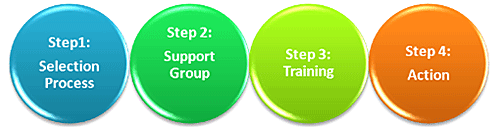
Step 1: Selection Process
- Each RA/RTs will select 3-5 participants to participate in the programme.
Step 2: Support Group
- Once the core members have been decided, they must set up the RIVER Ranger club under their RT/RAs.
- This Group will then have to set up a small working committee.
- Support from the local communities is important to ensure that the programme gets full cooperation from everyone.
Step 3: Training
- The selected local community (RA/RTs) will be trained based on training modules.
- Upon completing the modules, they will be given a certificate of recognition and they will be recognised as certified RIVER Rangers.
- As RIVER Rangers, they are responsible for educating fellow local community (RA/RTs) in their respective area on water resource management, water conservation, and sustainable water usage and wastewater management.
- At the same time, local community (RA/RTs) will be able to monitor and help conserve their local rivers and its basin.
- They should also prepare a Local Action Plan for their next course of action.
Step 4: Action
Their duties are to carry out river monitoring in their area and to undertake the following activities:
- Conduct river mapping activities to identify issues and problems in the local river basin.
- Develop a schedule for river observation, pollution and water quality monitoring.
- The compiled data will be exhibited on their individual blogs and shared by all parties involved in observation activities i.e. local communities (RA/RTs)
- They have to produce a summary report based on their observations and submit regular reports to their local politicians or relevant government agencies to initiate action against polluters.
- Start water management projects/initiatives
- For e.g. Water Conservation, Rainwater Harvesting, Water Recycling
- Local community (RA/RTs) will be encourages RIVER Rangers to be part of Something BIG for e.g. World Rivers Day and World Water Monitoring Day
>>> Visit the River Ranger website here.
|


 Target Groups